
Blinds vs Curtains: Which Suits the Room You Are Standing In
Choosing between blinds or curtains comes down to light control, wall space, cleaning and how the room is used. Blinds tilt or lower to set the light and sit close to the glass. Curtains draw aside, hang in front of the glass and need room on the wall for the track and the stacked cloth.

Light control and the view
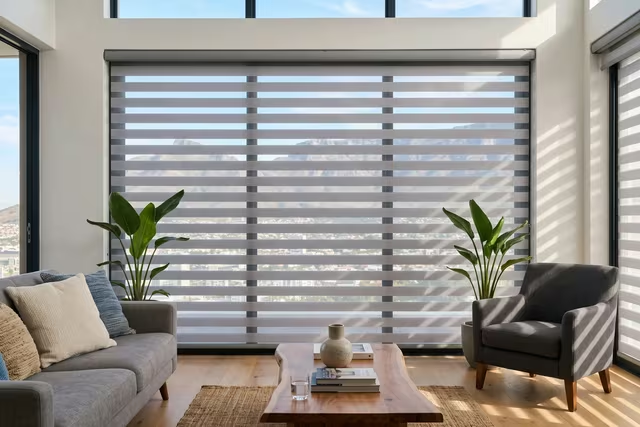
Modern blinds let you fine-tune how much light enters your space without closing off the whole opening. Venetian blinds tilt their slats, a roller stops at any height, and a day-night blind moves between sheer and solid bands.
Curtains adjust light by drawing across the opening; Venetian slats also let you change the angle of incoming light. Blinds give you that finer control, which helps in a home office with a screen or a lounge that takes the afternoon sun.
For blocking early light in a bedroom, the choice is blockout blinds with side channels or blackout curtains hung over the window. Using both on one opening gives the darkest result.
Curtains pros: warmth, softness and cover
Lined curtains hang a layer of cloth in front of the glass and can soften the sound of a home with hard floors. An awkward frame or an odd shape disappears behind curtains, and they add colour and pattern in a way a flat blind does not.
Curtains offer warmth as well. Drawn at night in cold weather, most conventional curtains and drapes reduce heat loss from a warm room by up to 10 percent, according to the US Department of Energy's guidance on window coverings.
Energy efficiency improves when curtains hang as close to the glass as possible, fall onto the sill or floor and are closed at the sides.
Cons of choosing curtains
Curtains need wall space beside the opening for the stack and a track or rod above it. In a narrow room, or beside windows that open inward, that stack gets in the way. As a window treatment, curtains offer less control over light than blinds do.
Curtains come down to be laundered or dry-cleaned, and lined curtains are heavy to take down and rehang. In wet rooms the cloth holds steam and grease. Aluminium and PVC blinds are typically more suited to kitchens and bathrooms, because they wipe down.
Energy efficiency at the glass
Heat loss is difficult to control through slatted blinds because of the gaps between the slats, as the same US guidance on interior blinds notes.
Summer turns that around. Closed and lowered on sunny windows, highly reflective blinds can reduce heat gain, and horizontal slats can be tilted to reflect direct sunlight onto a light-coloured ceiling. Drawn across hot glass in the afternoon, curtains do a similar job in a west-facing home.
Design and the look of the room
Design settles many of these choices. A roller or a Venetian keeps the opening neat and leaves the wall clear, which fits a minimal design. Curtains bring colour, pattern and height, and a track fixed just below the ceiling makes the glass look taller.
Wood slats and Roman shades sit between the two. Roman shades fold up in soft pleats like curtains but stay inside the frame, and timber slats give a blind a warmer design.
The right window treatment for a home often changes between rooms, so a house can carry blinds in one space and curtains in the next without looking mixed. Interior design magazines show that mix all the time, and it reads as a choice rather than a compromise.
How each one is kept clean
In a busy home, blinds are wiped or vacuumed where they hang to keep them clean, and the guide on how to clean blinds sets out the method for each material. Here curtains offer less choice: they come down for the wash, and the track gets a wipe while they are off.
Room by room
Across a home, the room decides which one goes where, and most houses end up with a mix.
- Bedroom: Blockout blinds, lined curtains or both together. Curtains work where the look of the room matters most; blinds work where the wall beside the bed leaves no space for a stack.
- Living room: A sunscreen or day-night blind for the day, with curtains for the evening on a wide opening.
- Home office or study: Blinds, because a screen needs the light set to a level rather than open or closed. In a study, curtains are there for the look.
- Kitchen and bathroom: Blinds in aluminium or PVC. Near a hob or a shower, curtains soak up grease and steam.
- Sliding doors: Curtains on a long track or vertical blinds both draw to one side, so the doorway stays clear.
Before you choose blinds or curtains for a room, check which way the glass faces, whether the room has to be dark, and how much wall there is beside the frame for curtains to stack.
Bay windows, tall windows and odd shapes
Bay windows take blinds fitted to each pane, or curtains on a bent track that follows the bay. Blinds keep each pane separate and tidy; curtains wrap the whole bay as one soft line, which gives the room a softer design.
Arched and angled windows are where curtains offer the easiest cover, because the track runs straight above the shape and the cloth hangs over it. Blinds are made to the exact size of each opening, which helps with the narrow windows beside a home's front door. Custom curtains are sewn to the drop you choose, from the sill to the floor.
In a rented home, curtains on an existing rod move with you when you leave; blinds are fixed to the frame and usually stay behind. That alone settles the choice for many tenants.
Using both window treatments together
A sunscreen blind and curtains on the same frame are a common pairing in a Cape Town living room. The blind handles the working day and cuts glare while the room stays bright; the curtains close at night for warmth, privacy and the look of the room.
Capetown Blinds supplies and fits the blind; the curtains and their track come from a curtain supplier.
Two window treatments on one opening means two purchases, so keep the pairing for the living room or the main bedroom, where both jobs come up daily. Each one then does the job it is good at.
| Blinds | Curtains | |
|---|---|---|
| Light control | Precise: tilt or part-lower | Open or closed |
| Insulation | Limited unless side-channelled | Good: traps air at the glass |
| Depth needed | Almost none | Track plus stack space each side |
| Cleaning | Wiped in place | Taken down and laundered |
| Typical cost | Lower per window | Higher once lined |
| Hides a poor frame | No: follows the outline | Yes: covers it entirely |
| Acoustics | No effect | Softens echo in hard rooms |
Products mentioned in this guide

Roller Blinds
Roller blinds are a single panel of fabric that winds onto a tube above the window.

Roman Blinds
Roman blinds are fabric blinds that draw up into horizontal folds and stack at the top of the window.
Day-Night Blinds
Day-night blinds are dual-layer roller blinds with alternating sheer and solid fabric bands that align to either filter or…
Request a quote
Send your details with the form, or message Capetown Blinds on WhatsApp.
Common questions on the comparison
Are blinds cheaper than curtains?
Yes, usually, on a like-for-like window. Blinds are priced by area and need no lining, heading tape or track, and they cost less to maintain because they are wiped rather than laundered. A large window with heavy lined curtains is normally the more expensive of the two.
Are curtains warmer than blinds?
Yes. A lined curtain traps air against the glass and reduces heat loss noticeably in winter, which a blind fitted inside the recess does not do to the same degree. In a cold south-facing room, curtains or a blind with side channels make a real difference.
Can you have blinds and curtains on the same window?
Yes, and it is a common pairing. The blind sits inside the recess and does the daytime work of controlling glare; the curtain closes over it at night for warmth and privacy. Specify the blind first so the curtain track can be fitted to clear it.
Which is better for a living room?
Choose according to how the living room is used. For screens and daytime work, compare the light adjustment of slats or rollers. For evening use, compare curtains or a Roman blind. Day-night blinds let you move between sheer and solid bands.
Should curtains match blinds?
No. Curtains and blinds in the same room need to work together in tone, nothing more. The blind is often a plain neutral, and the curtains carry the pattern and colour of the design.
Which window treatment is easiest to keep clean?
Blinds in aluminium or PVC, which wipe down where they hang. Curtains come down for washing, and a fabric blind needs a gentler clean than slats.