Motorised Blinds Cape Town: Motor Options for Roller and Outdoor Blinds
Motorised blinds are blinds raised and lowered by a tubular motor hidden inside the roller tube or headrail, worked by remote, wall switch or phone app instead of a chain or cord. Power comes from a rechargeable battery, mains wiring or a small solar panel. Capetown Blinds fits drives to new blinds and assesses retrofits to blinds it supplied earlier.

- Made-to-measure blinds, made to your exact window sizes
- Fabric and slat samples brought to your home
- Supplied and fitted, or supply-only if you prefer to fit them yourself
- 12-month workmanship guarantee on every installation
- Most blinds made and fitted within 7–14 working days of quote approval
Motor Options We Supply
Battery Motors, Designed for Retrofits
A lithium tubular drive charged by USB or a plug lead, typically holding several months of normal use per charge. There is no electrician and no wall chasing, which makes it the usual choice when the blinds already hang in the home.
Wired 230 V Motors
A permanently wired drive run off mains power, best specified before plastering on a new build or renovation. The wiring is done by a qualified electrician.
Solar-Charged Motors
A small panel on the window keeps the battery topped up, suited to high windows, stairwells and north- and west-facing glass that gets strong Cape sun.
Remote, Wall Switch and App
Handheld RF remotes and wall switches run one blind, a room or the whole house. A hub adds a phone app, timers and wind automation.
Retrofit to Blinds We Supplied
Many existing roller and day-night blinds supplied by Capetown Blinds can take a drive without replacing the blind. We check the tube diameter, blind weight and bracket type on site before quoting.
Motorised Blinds Specifications
| Drive types | rechargeable lithium battery, wired 230V, solar-assisted |
|---|---|
| Fitting | concealed inside the roller tube or headrail |
| Operation | RF remote, wall switch, phone app via a hub, timers and sensors |
| Compatible blinds | roller, day-night (zebra), blockout roller and outdoor blinds |
| Brands | Somfy and Somfy-compatible tubular motors |
| Typical charge interval | several months per charge under normal daily use |
| Best uses | large or high windows, stacker and sliding doors, stairwells, media rooms |
Pricing
Motorisation typically adds roughly R1,800 to R3,500 per blind on top of the blind itself, depending on the drive type, the blind size and whether you add a hub for app control. A battery retrofit to a blind we supplied sits at the lower end. Wired installations carry the electrician's cost separately. Ask for a price through the form, by phone or on WhatsApp.
Prices are indicative for the Cape Town area; the exact price comes with your quote. Compare every type per m² in our guide to blinds prices in Cape Town.
Get my exact quoteFitting and Setting Up Automated Blinds
Motorisation is fitted at manufacture or retrofitted on site: the tubular drive slides inside the roller tube or headrail, so nothing shows but the blind. Battery units need no wiring at all; wired 230 V motors are connected by a qualified electrician, ideally before plastering on a renovation. We set the top and bottom limits, pair the remotes and group channels room by room before we leave.
Every blind is measured and hung for you, with blinds installation included in the quoted price.
Charging and Care
A rechargeable unit needs a top-up roughly every three to six months, depending on use and the drive. Most charge through a USB or barrel lead clipped on in place. Recharge a blind that stops responding before checking the remote pairing. Clean the fabric as you would the equivalent manual blind.
When a mechanism or cord fails years down the line, the blind repairs service replaces the part rather than the whole blind.
Which Blinds Can Be Motorised
A drive works on blinds that roll or lift on a tube or headrail. It sits inside that tube, so the blinds look the same as manual ones, minus the chain at the side.
- Roller blinds: the usual starting point. Suitable sunscreen, blackout and day-night roller blinds can take a tubular drive, subject to the tube size, the blind's weight and the brackets, and motorised roller blinds are the common pick for wide lounge windows and stacker doors.
- Blockout roller blinds: in a bedroom, a remote lets you close the blinds from bed, and a timer can open them at the same hour each morning.
- Day-night blinds: both fabric layers wind on one tube, so a single drive runs the pair and the remote lines the bands up open or closed.
- Outdoor blinds: patio blinds are big and heavy, and a remote saves wrestling them by hand. A wind sensor can raise the blinds when the southeaster picks up.
Unlike curtain systems, which need a separate motorised track, blinds carry the drive inside their own tube or headrail. With battery drives, motorised blinds are becoming a simple retrofit rather than a building job.
Battery, Wired or Solar?
Battery drives are the usual pick for blinds that already hang in a finished home. Nothing is chased into the plaster, and the blinds keep their brackets wherever the brackets take a drive head.
Wired drives make sense when the walls are open anyway: a new build, a home renovation or a room being replastered. The electrician runs the cable to the window first, and the blinds go up once the walls are finished.
Solar drives fit blinds on high, bright windows where reaching a charging lead is a chore, such as stairwell glass and double-volume lounges. The small panel sits on the window beside the blind.
Sliding Doors, Stackers and Patios
Sliding and stacker doors carry the widest blinds in the home, and wide blinds are heavy to pull by chain. Roller blinds with a drive go up and down level, and several blinds across one opening can share a channel so they move together.
Outside the same doors, outdoor blinds on the patio can join that channel or run on their own with a wind sensor. Indoors and out, the remote does the work that used to need two hands on a chain.
Fabrics for Motorised Roller Systems
A drive does not narrow the fabric choice. Sunscreen roller blinds keep the view out to the garden, blackout roller blinds darken bedrooms and media rooms, and day-night blinds switch between filtered light and privacy with the bands. Your blinds are chosen from the same fabric range and samples as manual blinds, brought to your home, and the drive is sized to the fabric weight and the width at the measure.
Automatic Blinds, Room by Room
Automatic blinds open and close on a timer or a sensor, with no one standing at the switch. These are the rooms in the home where blinds on a drive make the most sense.
- Lounges and stacker doors: wide glass means wide, heavy blinds. One button lowers three or four blinds together, so they drop level instead of one at a time.
- Bedrooms: blinds on a timer close at night and open at the hour you choose, including on the weekend.
- Kitchens: blinds above a sink or a deep counter are awkward to reach, and a wall switch by the door solves that.
- Home offices: lower the blinds from the desk when glare hits the screens, without getting up.
- Media rooms: one button closes all the blinds in the room before a film.
- Stairwells and double-volume windows: glass nobody can reach without a ladder is the clearest case for a drive.
Home Automation, Timers and Scenes
A hub links automated blinds to a phone app and to home automation systems. From the app you set timers, group blinds by room and save scenes, such as an evening scene that lowers every street-facing blind at once.
A compatible brightness sensor can lower the blinds when west-facing glass gets brighter than a set level and raise them again when it dims. A wind sensor does the same job for patio blinds.
Without a hub, a handheld remote control still runs single blinds or whole channels. The hub is one of the products you can add later, so the blinds work from day one and the app comes when you want it.
Comfort, Privacy and Style
The day-to-day case is comfort. Blinds on a timer close when they should; blinds that need a walk to every window in the home often stay open.
Privacy is the second reason. Street-facing rooms can close at dusk on a schedule, even when nobody is home.
For anyone who finds a chain hard to pull, a remote puts every blind in the home within reach of the couch or the bed.
Then there is style. No chain hangs at the side of the window, and the drive sits out of sight in the tube, so motorised blinds look like manual blinds in the same fabric. You choose the fabric from samples brought to your home, the same way as for manual blinds.
Retrofit or Start Fresh?
A retrofit keeps the blinds you have and adds the drive, provided your blinds came from Capetown Blinds and the fabric is in good shape. Faded fabric, or blinds that no longer fit the window, point to new blinds with the drive built in, because the drive and the blinds are then made together.
Blinds from other suppliers are not retrofitted. For those windows the choice is new made-to-measure blinds, manual or with a drive.
Either way, the visit starts the same: samples brought to your home, the windows measured, and an itemised price for the blinds and the drive.
What We Check Before Fitting a Drive
A retrofit to existing blinds starts with a look at the blind and the window. These are the points we check.
- Tube diameter: the drive has to fit inside the roller tube the blind already has.
- Weight and drop: the drive is matched to the weight and drop of the blind, so a large patio blind and a small bedroom roller get different drives.
- Brackets: some brackets take a drive head as they are; others are swapped for ones that do.
- Remote, switch or app: which of these products you want, where the remote or wall switch will live, and whether the hub for the app comes now or later.
- Power: for a wired drive, whether there is power at the window. That part is the electrician's job.
A battery motor needs none of the power work, which is why it is the usual choice for retrofits to blinds already in the home.
Power Cuts and Charging
Battery and solar drives run off their own charge, so those blinds still open and close when the power to the home is off. Wired blinds wait for the power to come back.
Charging is a lead clipped to the drive for a few hours. Blinds on a solar panel top themselves up and rarely need the lead at all.
How It Works: From Quote to Fitted
- 1
In-home samples and measuring
Fabric and slat samples are brought to your home in greater Cape Town, and windows are measured for made-to-measure blinds.
- 2
Quote and fabric selection
You get an exact, itemised quote and help choosing the right fabric, slat or louvre for each room, the light you have and your budget.
- 3
Made-to-measure manufacturing
Once you approve, your blinds are manufactured to your exact sizes. Most blinds are ready within 7–14 working days of approval.
- 4
Professional installation
Blinds are fitted and the mechanisms checked. Supply-only is available if you prefer to fit them yourself.
- 5
Aftercare & 12-month guarantee
Every installation carries a 12-month workmanship guarantee, and we are a phone call away for adjustments, spares or repairs down the line.
Request a quote
Send your details with the form, or message Capetown Blinds on WhatsApp.
Motorised Blinds: Questions We Get
How much do motorised blinds cost in Cape Town?
Motorisation adds about R1,800 to R3,500 per blind on top of the blind, depending on the drive, the blind size and whether you add a hub for the app. A rechargeable battery retrofit to a suitable blind we supplied is the cheapest route; a wired 230V installation costs more once the electrician is included.
Can existing blinds be motorised?
Yes. Many existing roller and day-night blinds supplied by Capetown Blinds can be motorised without replacing the blind. It depends on the tube diameter, the weight and drop of the blind and the bracket type, so Capetown Blinds checks those on site before quoting a retrofit.
Can you motorise blinds I bought somewhere else?
No. Retrofits are done only on blinds supplied by Capetown Blinds. For blinds from another supplier, the route is new blinds with a drive, made to your window sizes.
Do motorised blinds need wiring?
No. Rechargeable battery motors need no wiring at all and are the usual choice for existing homes. Wiring is only needed for 230V motors, which suit new builds and renovations where the cable can be run before plastering.
How often do battery blind motors need charging?
A rechargeable tubular drive typically runs several months per charge under normal daily use. Charging takes a few hours through a USB or plug lead, and a solar panel on a bright window can keep the battery topped up so it rarely needs manual charging.
Can motorised blinds work with a phone or smart home?
Yes. Adding a hub puts the blinds on your phone and allows timers, scenes and wind automation. Somfy-compatible motors integrate with common smart-home systems, so blinds can close automatically in the afternoon sun or when the southeaster picks up.
Are motorised blinds worth it for large windows?
Yes, especially on large, high and hard-to-reach windows. Stacker doors, stairwell glass and wide living-room spans can be awkward to operate by chain. Choose the remote, switch or app according to the blind's weight and how you will reach it.
Does every window need a motor?
No. A drive is not a must-have on every window. It pays off on wide, heavy or out-of-reach blinds, while a chain does the job on a small bathroom or kitchen blind. Plenty of homes mix the two: motorised blinds on the stacker doors and manual roller blinds in the smaller rooms.
Can one remote run all the blinds in the house?
Yes. A multi-channel remote runs a single blind, a room of blinds or every blind in the home, and a wall switch can sit by the door of each room for the people who never find the remote.
Is there a guarantee on motorised blinds?
Yes. Every installation carries a 12-month workmanship guarantee, and that includes blinds fitted with a drive.
How long do motorised blinds take?
Most blinds are made and fitted within 7-14 working days of approval. The drive is set up on the fitting visit: limits set, remotes paired and channels grouped before the fitter leaves.
Can I see the fabrics before choosing?
Yes. Fabric and slat samples are brought to your home, so you choose the fabric for your blinds in the room where they will hang.
Related Blinds
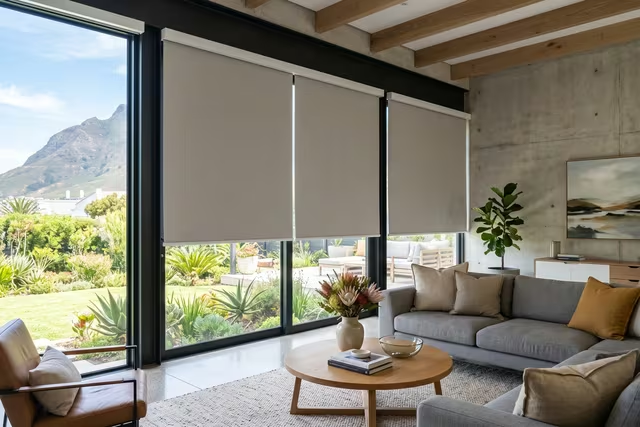
Roller Blinds
Roller blinds are a single panel of fabric that winds onto a tube above the window.
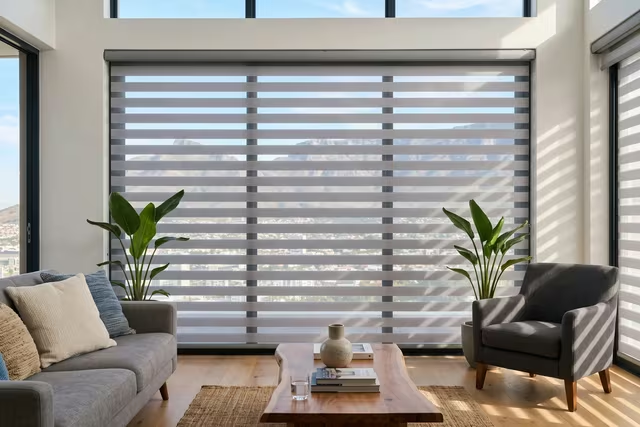
Day-Night Blinds
Day-night blinds are dual-layer roller blinds with alternating sheer and solid fabric bands that align to either filter or…
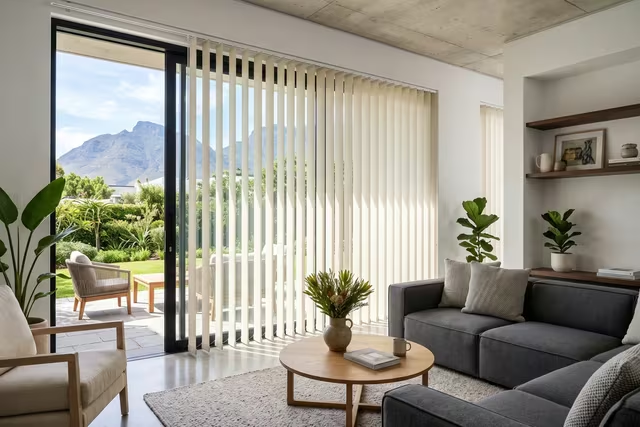
Vertical Blinds
Vertical blinds are fabric vanes that hang from a top track, draw aside for a full opening, and rotate to control light and…
Serving the Greater Cape Town Area
Blinds are supplied and fitted across greater Cape Town, in the areas below.
Southern Suburbs
Constantia · Claremont · Newlands · Wynberg · Tokai · Bishopscourt · Kenilworth · Rondebosch · Plumstead
Northern Suburbs
Durbanville · Bellville · Brackenfell · Parow · Goodwood · Kraaifontein · Kuils River
Atlantic Seaboard
Sea Point · Camps Bay · Clifton · Green Point · Bantry Bay · Mouille Point
City Bowl
Cape Town CBD · Gardens · Tamboerskloof · Oranjezicht · Vredehoek
West Coast
Bloubergstrand · Table View · Milnerton · Montague Gardens · Parklands · Sunningdale
South Peninsula
Fish Hoek · Simon's Town · Muizenberg · Kalk Bay · Noordhoek
Helderberg
Somerset West · Strand · Gordon's Bay
Winelands
Stellenbosch · Paarl · Durbanville Hills · Brackenfell